



How to Choose a Wearable Remote Control Vibrator

A wearable remote control vibrator should do more than turn on without being held. It needs to maintain useful contact, remain comfortable in the position where you plan to wear it and give the wearer a fast way to stop it.
Those requirements make wearable vibrators harder to choose than ordinary handheld toys. A product that feels secure while lying down may shift when sitting. A panty vibrator that works with one style of underwear may feel unstable with another. An insertable wearable may stay in place internally while losing external contact.
This guide explains how to compare wearable designs by fit, stimulation type, control system, movement, noise, materials and safety. It also includes two examples to show how different wearable structures solve different problems.
What Counts as a Wearable Remote Control Vibrator?
A wearable vibrator should remain in a useful position without requiring the user to hold it continuously. It may be secured by underwear, a strap, a magnetic clip, an insertable section or a design intended to be worn during partnered sex.
Remote control can mean a separate handheld controller, nearby Bluetooth control or an internet-enabled app. These control methods do not provide the same range.
A handheld clitoral stimulator does not become wearable simply because it connects to an app. If the user must continuously hold the product against the body, it belongs in a different category.
| Wearable type | How it stays in place | Main stimulation | Best suited to | Main limitation |
|---|---|---|---|---|
| Panty-style vibrator | Underwear, straps or an integrated garment | External clitoral vibration | Users who do not want insertion | Contact changes with clothing and movement |
| Insertable egg | Internal shape and pelvic muscles | Internal or G-spot vibration | Users who enjoy insertion | May shift or rotate during movement |
| Butterfly or dual-contact wearable | Insertable section plus external body contact | Internal and external stimulation | Users who want two contact points | Fit depends heavily on anatomy |
| Wearable couples vibrator | Flexible arms, ring or insertable body | Internal, external or shared vibration | Partnered sex | Available space and position affect comfort |
How We Evaluate Wearable Vibrators
Wearable testing should not stop at turning the product on while lying still. We consider how the toy is positioned, whether contact changes while sitting or moving, how easily the controller responds and whether the wearer can stop the product directly.
We also examine material feel, seams, pressure points, noise, cleaning access and the difference between manufacturer claims and practical use.
Fit remains personal. A wearable shape that stays aligned for one body may need frequent repositioning for another. Hands-on observations describe the testing experience and should not be treated as a universal comfort guarantee.
Start With the Wearing Method
The most useful first question is not whether you want a remote or an app. It is how you want the product to stay against the body.
Panty-style wearables
Panty vibrators position a motor or stimulation pad against the external clitoral area. Some are built into a garment, while others sit inside ordinary underwear or attach magnetically.
They do not require insertion, making them accessible to users who prefer external stimulation. However, contact depends on the garment. Loose fabric may allow the vibrator to move, while very tight underwear may create uncomfortable pressure.
Insertable wearables
Insertable eggs and curved wearable vibrators rely on their shape to remain inside the body. They can provide internal pressure or vibration without being held.
Before choosing one, check the insertable length, widest point, curve and retrieval section. A design that is too small may rotate, while a shape that is too large may become uncomfortable during extended wear.
Dual-contact wearables
These products combine an insertable section with an external arm, pad or butterfly-shaped body. They can offer internal and clitoral contact at the same time, but both sections must align with the wearer’s anatomy.
More contact points do not guarantee a better fit. If one section feels well positioned while the other requires force, the shape may not be suitable for that user.
Choose External, Internal or Dual Stimulation
The controller cannot compensate for the wrong stimulation type. Decide what you want to feel before comparing range, apps or vibration modes.
Choose external stimulation if:
- You do not want insertion
- You prefer direct or indirect clitoral contact
- You want a product that is easy to remove
- You are comfortable using underwear or straps for support
Choose internal stimulation if:
- You already know you enjoy insertion
- You prefer internal vibration or G-spot pressure
- You have checked the insertable dimensions
- You can remove the product easily without relying on its controller
Choose dual stimulation if:
- You want internal and external contact together
- You are willing to test different positions
- The product’s dimensions are compatible with your body
- The external section is flexible enough to adjust comfortably
Lovetremor Flutter

Flutter illustrates the dual-contact approach. Its butterfly-shaped body combines an insertable section with external contact, while a separate wireless remote provides nearby control.
The manufacturer lists nine vibration modes, nine movement modes, approximately one hour of use, IPX6 water resistance and a published noise level of 50 dB or lower.
The physical remote is the main reason to consider this type of wearable. It does not require an account or phone, and the buttons are easier to identify by touch than controls on a screen.
The tradeoff is fit. Dual-contact wearables depend on the relationship between the internal section, external body and wearer’s anatomy. Flutter maintained more predictable contact while stationary than during active movement in our testing.
Physical Remote or App Control?
Physical remotes and apps are both useful, but they solve different problems. The correct choice depends on where the controlling partner will be and how much setup you want.
| Control type | Best use | Main advantage | Main limitation |
|---|---|---|---|
| Physical wireless remote | Solo and same-room partner play | Fast, tactile and phone-free | Limited nearby range |
| Direct Bluetooth app control | Nearby smartphone control | More detailed settings | Bluetooth alone cannot work across cities |
| Internet partner control | Long-distance couples | Approved control can work between cities | Requires phones, accounts and internet access |
Why choose a physical remote?
A physical remote keeps setup simple. It can be passed directly to a nearby partner, and the controls can often be used without looking.
It also keeps phones and notifications out of the experience. This is useful when you only need basic intensity and pattern controls.
Why choose an app?
An app can display patterns, sliders and separate function controls more clearly than a small remote. It may also support partner access through the internet.
“App-controlled” does not automatically mean unlimited range. Confirm that the product supports internet partner control rather than nearby Bluetooth alone.
Check Stability in the Position You Will Use
“Wearable” does not mean stable in every position. Gravity, muscle movement, clothing and body angle all affect contact.
Consider the actual situation rather than the lifestyle image on the product page. A toy intended for lying down does not need the same support as one intended for walking or partnered sex.
Evaluate fit in four situations
- Lying down: Does the product remain aligned without being held?
- Sitting: Does body weight create uncomfortable pressure?
- Walking: Does the product rotate, slide or pull against the skin?
- Partnered sex: Is there enough space for the product without pinching either person?
Test a new wearable privately before relying on it in another setting. Begin with short periods and check the skin for irritation or pressure marks.
Underwear and Clothing Matter
External wearables often depend on underwear to maintain contact. Soft, supportive fabric usually provides more predictable positioning than loose material.
Very thick fabric can reduce vibration transfer, while seams may push the toy away from the intended area. Extremely tight clothing can create excess pressure and make the outline of the product more visible.
If the wearable includes its own garment, check the adjustable range rather than relying only on a general size label. The location of the stimulation section matters as much as the waistband measurement.
Lovetremor Vela
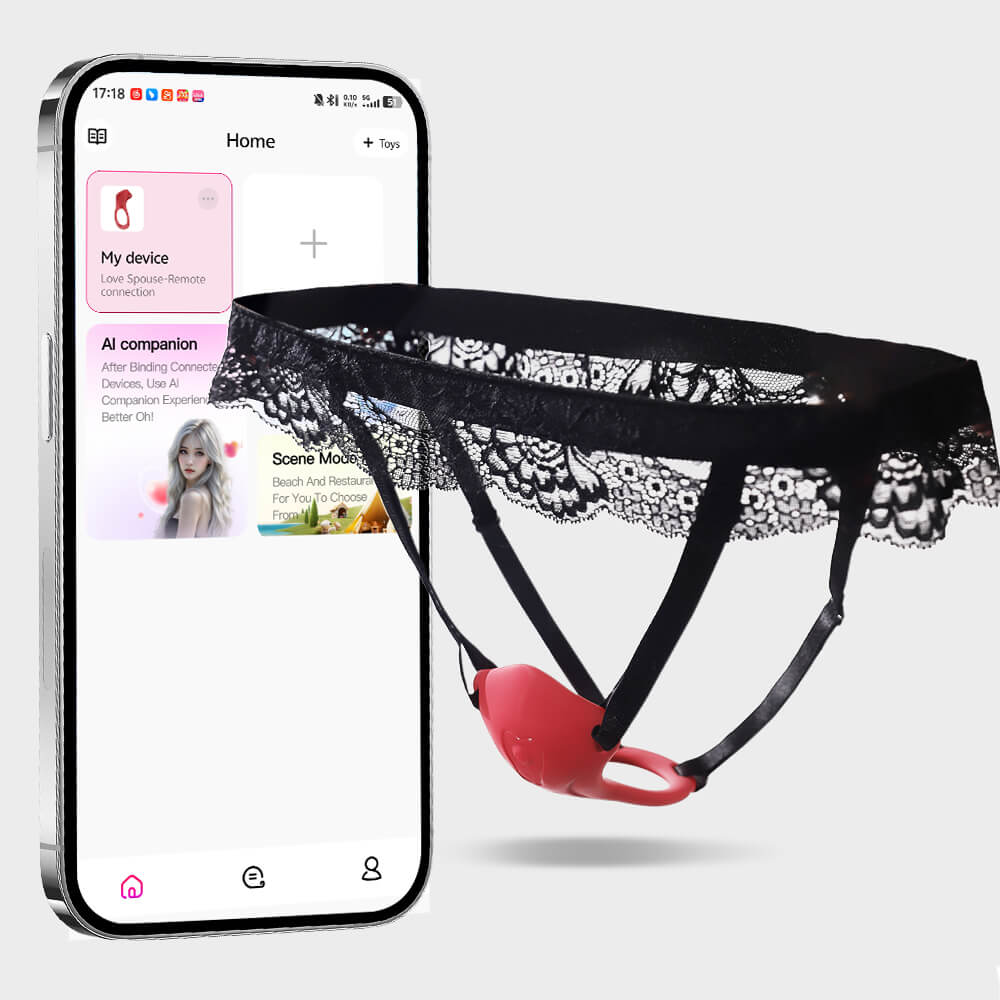
Vela represents the panty-style approach. Its wearable structure positions the vibrator against the external clitoral area, while an adjustable waistband supports different body sizes.
The product also includes a soft, flexible central ring intended for couples use. The app controls nine vibration modes, making Vela more suitable for users who want external wearable stimulation and phone-based partner control.
Published specifications include ABS and silicone construction, approximately two hours of charging, about one hour of use, nine vibration modes, IPX6 water resistance and a noise claim of 60 dB or lower.
Garment fit is the main consideration. The stimulation section must remain in the right position without the waistband feeling too tight. It is sensible to test Vela while standing, sitting and moving before using it for an extended session.
Do Not Choose by Mode Count Alone
Nine or ten modes can sound impressive, but fit and control matter more. A wearable vibrator cannot deliver useful stimulation if it repeatedly moves away from the intended area.
Consider the lowest intensity as well as the highest. Beginners and sensitive users may need a gentle starting level, especially when clothing presses the motor closer to the body.
A steady mode can be easier to control than a changing pattern. Pattern changes may also sound more noticeable in a quiet room.
Noise Claims Need Realistic Expectations
A published noise figure does not guarantee that another person cannot hear the toy. Sound changes when the vibrator touches the body, clothing, a chair or bedding.
Hard surfaces can amplify vibration, while fitted clothing may reduce some airborne sound. Test the product in the intended room instead of depending only on a decibel claim.
Wearable and discreet are not synonyms. A product can be hidden visually but still create audible vibration.
Public Use Requires More Than Discretion
Some wearable vibrators are marketed with restaurants, dates or public settings. Discretion does not remove the need to consider consent, local rules and the people around you.
Do not use a wearable vibrator in a way that exposes non-consenting people to sexual activity. Avoid situations where sudden movement, sound or loss of control could create distress or unwanted attention.
A private home, hotel room or other appropriate adult setting is usually better for testing a new wearable product.
Keep the Wearer in Control
The wearer should know how to turn the product off directly. A physical remote can be dropped, an app can disconnect and a phone can run out of power.
Before giving control to a partner, test the onboard button and agree on a clear stop signal. Confirm which settings are acceptable and whether the partner may change intensity without asking again.
Review App Privacy Before Connecting
App-controlled wearables introduce account and permission considerations that do not apply to a basic physical remote.
Use a unique password if the app requires an account. Share control through the official partner invitation system rather than giving someone your password.
Review requested permissions, manage lock-screen notifications and remove partner access when it is no longer wanted. Keep the app and phone operating system updated.
Check Materials and Lubricant Compatibility
Review every part that touches the body. Many wearable vibrators combine silicone, ABS plastic, fabric, elastic or metal components.
Use water-based lubricant with silicone components unless the manufacturer explicitly confirms another formula is compatible. Silicone-based lubricant can affect some silicone surfaces.
A panty-style product may have separate cleaning instructions for its electronic module and garment. Remove detachable electronic parts before washing the fabric when instructed.
Understand the Water Rating
Water-resistant does not always mean submersible. IPX6 indicates resistance to powerful water jets, but it is not the same as an IPX7 rating for temporary immersion.
Follow the product instructions when cleaning. Avoid soaking charging contacts, controllers or non-waterproof fabric sections.
Dry every part fully before storage. Moisture trapped between silicone and fabric can create odor and hygiene problems.
Battery and Charging Questions to Ask
- How long does the toy take to charge?
- What runtime does the manufacturer publish?
- Does the controller require a separate battery?
- Can the charging cable be replaced easily?
- Does the app show the remaining battery level?
- Can the product be stopped if the phone disconnects?
Published runtime is normally measured under specific conditions. Higher intensity, multiple motors and cold temperatures may reduce actual battery life.
Common Wearable Vibrator Buying Mistakes
- Choosing the controller before the wearing method. Decide how the product will stay against the body first.
- Assuming wearable means suitable for walking. Some products are intended mainly for stationary use.
- Ignoring dimensions. Product photographs do not communicate insertable size accurately.
- Assuming App control means unlimited range. Cross-city play requires internet partner control, not Bluetooth alone.
- Buying by mode count. Fit, starting intensity and control response matter more.
- Expecting one dual-contact shape to fit every body. Internal and external contact points vary by anatomy.
- Confusing hidden with silent. Clothing may hide the toy without eliminating its sound.
- Giving away the only stop control. The wearer should always be able to turn off the product.
Final Buying Checklist
- Do I want external, internal or dual stimulation?
- Do I want insertion?
- Will I use the product lying down, sitting, walking or during partnered sex?
- How does the product remain in place?
- Are the insertable dimensions appropriate for me?
- Will my underwear or clothing support the design?
- Do I need a physical remote or an app?
- Will the controlling partner be nearby or in another city?
- Can I stop the vibrator directly from its body?
- Does it offer a comfortable low setting?
- Does the water rating match how I plan to clean it?
- Have I checked battery life, warranty and hygiene return conditions?
Final Verdict
The best wearable remote control vibrator is the one that remains comfortable and aligned in the position where it will actually be used. Start with the wearing method and stimulation type, then compare the controller, range and pattern options.
A physical remote is usually the simplest option for nearby partner play. An app provides more detailed control and may support internet partner access. Panty-style products suit users who want external stimulation, while insertable and dual-contact wearables require more careful attention to dimensions and anatomy.
Test every new wearable privately, begin with short sessions and keep the wearer in control. If you want to compare wearable models with other remote and app-controlled designs, read our hands-on guide to the best remote control vibrators .
FAQ
What is a wearable remote control vibrator?
A wearable remote control vibrator stays against or inside the body without being held continuously. It may be secured by underwear, a garment or an insertable section and controlled through a physical remote or smartphone app.
How do I know whether a wearable vibrator will fit me?
Check its dimensions, flexibility and wearing method instead of relying on promotional images. Compare insertable measurements with a toy you already find comfortable. For panty-style products, check the waistband range and position of the motor. No fixed shape fits every body equally well.
Do wearable vibrators stay in place while walking?
Not always. Stability depends on anatomy, product shape, underwear and movement. A toy that remains aligned while lying down may shift when sitting or walking. Test it privately in several positions before extended wear.
Is a physical remote better than app control?
A physical remote is usually simpler for nearby use and can be operated without looking at a screen. An app may provide more detailed adjustments, custom patterns and internet partner control. Choose according to where the controlling partner will be.
Can a wearable vibrator be controlled from another city?
Only if its app explicitly supports internet partner control. Physical remotes and direct Bluetooth connections have limited nearby range. “App-controlled” does not automatically mean unlimited distance.
Can a wearable vibrator be used during partnered sex?
Some models are designed for partnered sex, but comfort depends on their shape, position and the space between bodies. Test the fit beforehand and stop immediately if either partner experiences pain, pinching or excessive pressure.
How long can I safely wear a wearable vibrator?
There is no universal time limit because size, pressure and individual sensitivity vary. Begin with a short private session and remove the product if you notice pain, numbness, irritation or persistent pressure marks.
How should I clean a wearable vibrator?
Follow the product’s water rating and care instructions. Clean body-contact surfaces before and after use, remove electronic components before washing fabric when instructed, and allow every part to dry completely before storage. IPX6 products should not automatically be treated as submersible.


